Friday, August 27, 2010

A Healthier Pie Crust

A Healthier Pie Crust


As some of you may know,  I've been going through my stacks of collected recipes.  Some of these recipes go back to the mid 1990's.

My hubby "suggested" that I toss the beloved stack.  However, I told him that I've give myself a year to try as many as possible before tossing the rest.  We have been trying the recipes, a few a week.  Actually, what's happened is that we have found many new favorites!  We both decided to remove the deadline, as long as we tried some new recipes each week.

This pie crust recipe comes from a 1996 Vegetarian Times issue, where the author remakes lemon meringue pie.  The filling is a mixture of lemonade and kudzu to thicken it, which didn't interest me.  

I am guessing the article was saved for the pie crust recipe. And I am glad I saved it!  It is a good tasting "from scratch" recipe,  and not one that uses a lot of butter, margarine, shortening, or sugar.  It's not as flaky as a crust with shortening, but it's a great tradeoff.  My husband gave it a "10", that being the highest score.  However, we don't eat a lot of pies for him to compare.  Still, we both felt it was really good, and light tasting.  Small tradeoffs can add up toward better health and weight management.

If you want to avoid a lot of saturated fats, this is a great recipe.  We hope you enjoy it also:

A Healthier Pie Crust
Adapted from Feb. 1996, issue, Vegetarian Times
Makes one crust

1 Cup             unbleached white flour
1/2 Cup          whole wheat pastry flour
1/4 tsp            salt
1 to 1 1/2 tsp  baking powder (I used a rounded tsp)
4 TBSP          canola oil  (chilled, preferably)
5 TBSP          apple juice, chilled (use 6 TBSP, if needed)

Preheat oven to 350 degrees.  

     ***Sift flours, salt and baking powder.  Add oil, mix lightly with a spatula until oil is absorbed.  Add 5 TBSP apple juice; mix again to form a ball.  Add additional apple juice if necessary.  Knead gently 1 minute, or until smooth.  Flatten dough into a disk shape, cover with plastic wrap and chill 30 minutes in the coldest part of the refrigerator.
     Roll out dough on floured surface, 1 -2 inches larger than a 9" pie pan.  Fit dough into lightly oiled pan, easing dough along sides.  Trim excess to edge of pan, crimp with fork.  Chill 20 minutes or more.  Tightly line bottom of crust with aluminum foil, weight with rice, dried beans or pie weights.  Bake until light brown and crisp, 20 to 30 minutes.  If you want, remove the weights after 15 minutes and bake the crust a bit longer to bake the bottom.  It seemed to make a sturdier crust.
     Cool pie crust on a rack.  Fill as usual.

Note:  ***I made this crust quickly in the food processor.  The dry ingredients were mixed and then the oil.  Finally,  5 TBSP chilled apple juice was added.  A few bursts of the food processor kneaded the dough.  After removing the craggy mixture from the food processor, I formed the dough into a ball.  It didn't seem to need more apple juice, because it held together quite well.  Finally, the dough was flattened into a disk and wrapped in plastic wrap for chilling in the fridge.


  The crust, ready for filling!


My yummy (and first ever) lemon meringue pie!!!  We really enjoyed this pie, and the crust was just right for the light taste.


Thanks for coming by.  Happy Baking!  I would love to hear your comments, so please leave one below.  And don't forget to return soon, for my next post.

Judy

Thursday, August 26, 2010

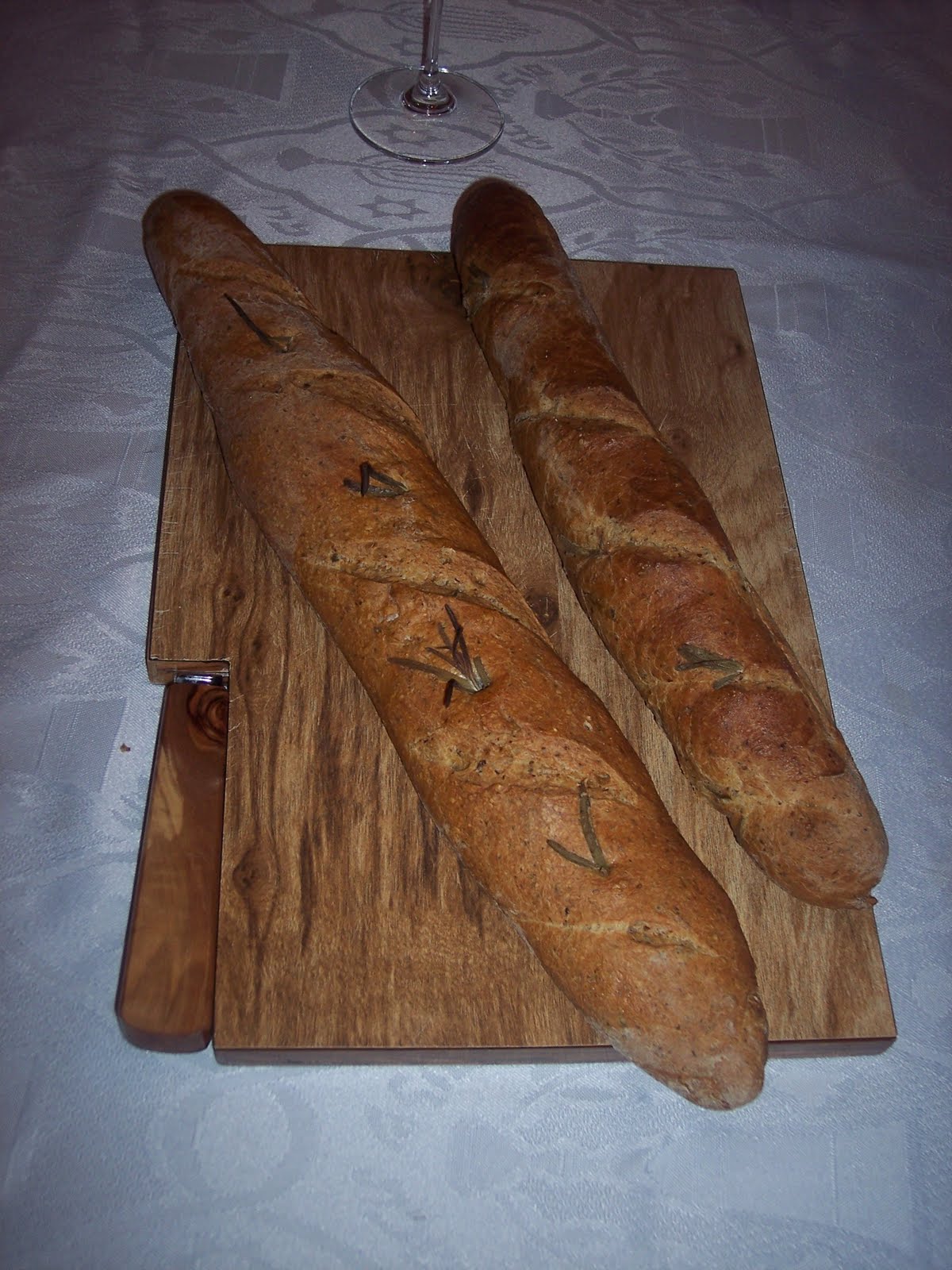
Rosemary Flax Baguette

Rosemary Flax Baguette


The whole wheat dough for these baguettes was really easy to use.  It was much stiffer than the dough using all purpose flour, making the shaping much easier.  I baked these baguettes twice, using  stored dough.  

The first time, they were baked on my baguette pan.  Parchment paper was used so the dough wouldn't seep through or stick:


Halfway through baking time, I took the baguettes off the baking pan and put them directly onto the stone that was in the oven.  This gave the bottom of the baguettes a nice crust:


Energy saving tip:  Instead of heating up the oven twice for baking, I baked my blueberry pie first.  Then I heated up the oven higher for the baguettes.  It takes a half hour to heat up the oven, but it the oven was pretty hot by the time I baked the baguettes:


Nice crumb, crust on the baguettes.  Great whole wheat and rosemary flavor!


There was just enough dough for a second baguette, later in the week.  It's great to have stored dough in the fridge--no need to mix up another batch of dough.  This time, I did a "freehand" shape:


It looks like the baguette pan makes smaller loaves.  The loaf on the left is the freehand loaf.  The one on the right was baked in the baguette pan.


The baguettes were especially enjoyable when we dipped them into olive oil!


This bread is one of the breads from the "Healthy Breads in 5 Minutes a Day" book.
The HBinFive Baking Group, started by Michelle of Big Black Dogs, is baking through all of the breads in this book.  To see what my HB5 baking buddies have made recently, check out The 17th HBin5 Bread Braid

Thanks for stopping by to visit!  Come back soon, I'll be baking again often.  I hope you will leave a comment below.

Judy

Wednesday, August 25, 2010

Vollkornbrot: 100% Whole Grain Bread, and My Favorite Gazpacho

Vollkornbrot: 100% Whole Grain Bread, and My Favorite Gazpacho


Hearty bread lovers, this is one for us!!!

Honestly, I wasn't sure I would like this bread.  It sounded too dense--rye flakes, whole wheat flour, wheat berries.  All purpose flour wasn't used, and the dough wasn't enriched with eggs or milk.


Wow, this bread is wonderful!  As soon as I bit into my first bite, I said "where is the deli mustard!?"  This bread can really stand up to hearty sandwiches. 


The wheat berries and rye flakes came from my local health food store.  The dough seemed wetter than usual.  However, the recipe didn't say to presoak the wheat berries.  After 24 hours, the wheat berries had soaked up much of the excess moisture.  


I rolled out the dough into a rectangle.  My favorite 4 sided folding method gives the breads a nice rectangle shape.  For more information, check out my prior post: Folding technique for a rectangular loaf
The instructions are in the middle of the page.


After placing the dough in the loaf pan, I covered it with a shower cap to rise.  Shower caps work wonderfully.  It's fun to repurpose household items; it saves me from using plastic wrap.  

We really enjoyed the finished bread with a chicken cacciatore dinner.

The leftover bread made wonderfully hearty croutons when mixed with olive oil, garlic powder, onion powder and Italian seasoning.   They were baked in a 450 degree oven, just after I took something else out of the oven--energy saving!


The croutons seemed just perfect for a cold summer soup.  To me, nothing screams "summer" to me like gazpacho or ratatouille. So, this month, I decided to make my favorite gazpacho recipe.  Here's my favorite low calorie recipe, which is delicious!.


Gazpacho (Chilled Salad Soup)
Adapted from Weight Watchers
(Makes 4 servings)


1 cup tomato juice**** (see substitutions below)
1 packet or tsp instant beef broth and seasoning mix
2 medium tomatoes, chopped
1 medium cucumber, peeled and chopped
1/2 cup diced celery
1/2 cup diced green bell pepper
1/4  cup diced onion
1 TBSP olive oil
2 tsp red wine vinegar
1 tsp lemon juice 

3-4 garlic cloves (less, if you don't like garlic)
1/4 tsp salt
dash pepper
2 drops hot sauce (I use 1/4 tsp cayenne pepper)

Combine tomato juice and broth mix in a small saucepan and bring to a boil.  Remove from heat and let cool.  Combine remaining ingredients in work bowl of a food processor.  Process until
vegetables are finely chopped.  Add cooled tomato mixture;
process just until combined.  Refrigerate at least 2 hours, preferably
overnight, before serving.


*** can substitute 1/2cup tomato sauce & 1/2cup water or 1 cup water, several TBSP tomato paste, salt and pepper. Whatever you have on hand.
 

About the HBinFive Baking Group
The HBinFive Baking Group, started by Michelle of Big Black Dogs, is baking through all of the breads in the Healthy Bread in Five Minutes book. To see what my HB5 baking buddies have made recently, check out The 17th HBin5 Bread Braid

Thanks for stopping by to visit!  Come back soon, I'll be baking again often.  I hope you will leave a comment below.

Judy

Friday, July 30, 2010

Kitchenaid Mixer tips!

Kitchenaid Mixer tips!

My new mixer has enough space under the cabinet!

I've been wanting a mixer for about 6 months, and I think I've told just about everyone my quest.  Bed, Bath & Beyond was really nice--they let me spend time with both the Kitchenaid and Cuisinart mixers.  

Also, there were so many conflicting reviews!  Even Consumer Reports was confusing--they reviewed the Kitchenaid mixers highly, but the consumers rated them low.  Consumers talked about overheating, plastic gears, and oil leaking.

My choice wasn't getting to a final purchase, so I called Kitchenaid for help.  I spoke to a rep named Jordan, who explained that most of the problems listed are incorrect usage problems. She said that many people aren't using the mixers the way they are meant to be designed.

She suggested that I read my manual thoroughly, and start with some of the recipes in the book. Non-Kitchenaid recipes need to be modified, and the book will serve as a guide.

To remind myself, and help my baking buddies, I am listing the comments from the various reps with whom I spoke on several calls my first days of using my new Kitchenaid Pro 600 mixer: 


Kitchenaid Mixers, Per Jordan, rep, 7 21/10


This machine is made to be used really often, preferably daily.  It was made to get women out of the kitchen so they would spend more time with their families.  (Ha, Ha!  Women like it so much that they spend more time with it!)  Jordan said the overheating and oil leaking complaints are usage problems.

Oil leaking complaint:
Kitchenaid uses a food grade lubricant; they can't use an industrial lubricant in case it gets into the food mixed. 
It does break down. The heat of mixing will keep the food grade lubricant oil as a solid.  If you don't use the machine really often, run it for 2 minutes at speed 10 every 2-3 weeks (on speed 2,  if it's humid here).  Otherwise, the oil will separate.

Overheating complaints:

The machine will overheat and shut off if too much flour is added at once, or a speed over #2 is used.  If recipe not in Kitchenaid care guide, have to modify recipe.  Use this mixing guide:

***For non-Kitchenaid recipes, modify the recipe so don't have too much flour in the beginning.  Add liquid first, then about 4 cups of the flour.  Add remaining flour slowly.   

***Cut mixing time in half, or less.  (Another rep said For every 10-12 minutes of mixing with another electric mixer or by hand, = 2 minutes with Kitchenaid!)
***If the dough is climbing up the dough hook, you are overkneading.

***For breads, don't go above speed 2--use only speed 2!

Add ingredients, go to stir speed to incorporate flour and then go to speed 2.  Mix no more than 5-6 minutes.  Dough hook mixes and kneads.  Cuts down work time.


For 6qt bowl, don't use recipes containing more than:
14 cups white flour OR
8 cups high gluten/bread/specialty flour


A number of people in my baking group mentioned that their mixer overheats.  I am guessing that they might not be modifying their recipe to the mixer's needs.  The recipes from "Healthy Bread in 5 Minutes a Day" call for putting the dry ingredients into a bowl and then adding the liquid.


I called Kitchenaid about that, because it seemed different from the recipes in the manual.  Candy, the rep said to follow the method of the recipes in the manual.  If I use my mixer for my HB5 recipes, I asked if I could my dry ingredients in a separate bowl.  Then I could put the liquid into the mixer's bowl, add about 4 cups of dry mixed ingredient, stir, and then add the remaining flour mixture slowly.  Candy agreed that would work better.

Differences between Pro6qt and Professional 600:
  • Pro 6qt --11 wires on wire whip, less colors (have onyx black).  same wattage, 575 watts, like Pro 600
  • Professional 600--9 wires on whip (not much difference), 575 watts, more colors. 
Both have all metal gears and transmission.  Auto reset, turns off if it gets too hot, shuts off, slow start--starts show and speeds up.   
 

A Later call tip--use the mixer as much as possible the first month.  Any manufacturing defects will show up the first month.

I look forward to using my new mixer!!!


The look of baking joy!!


First loaves of bread--white bread and cinnamon-raisin bread. The dough was lucious!

Look how high they rose!   WOW!!!


 8/9--I had some leftover bread, and decided to make a berry fruit bread pudding that was posted in a King Arthur flour email for Classic Summer Pudding

However, we found we had eaten half the loaf of the white bread.  The raisin cinnamon loaf, pictured on the right, just didn't seem right for the recipe.  Also, I didn't want to heat up the house by turning on the oven.  

The solution seemed to be to make a loaf of white bread in my bread machine.  We hadn't used the bread machine to bake a bread in over a year.  I couldn't believe how much better my breads look now, compared to using the bread machine--no hole where the paddle was, better texture and taste.


Both breads, combined, did make a great fruit/bread pudding with a 4 fruit mixture.  And the crusts are being used for Jim Lahey's chocolate torte!

Happy Baking, hope these tips are helpful to you.  Please leave a comment about your mixer. 

Pistachio Twist Bread

Pistachio Twist Bread
For the 16th HBinFive Bread Braid


YUM!  This bread was one of the first assignments for the newly formed "Healthy Bread in 5 Minutes a Day" baking group.  It was made with the "braided challah with whole wheat and wheat germ" dough.  I left out the wheat germ, and added flour to make the right consistency.  Rose water flavored the pistachio filling wonderfully.  

We took the bread to a holiday party, and people couldn't stop nibbling it!

For months, I have been craving this bread.  A friend of mine went to Trader Joe's in another city and brought me back bags of shelled pistachios.  I knew just what I was going to do with them!!!

Half a recipe, which is 2 breads, seemed like a good idea.  One for us, and one for a friend.  I usually space out my baking, so one night I put all the dry ingredients (minus the yeast) into my dough bucket. 

The next morning, I added the yeast, and the liquid ingredients.  Why does the dough look so watery?  

I began adding flour to the mixture, trading off between white whole wheat and unbleached all purpose.  Finally, I figured it out (you probably figured it out, too!)--I had added enough water for a full batch.  I added the remaining ingredients to make full batch, and added enough flours to make the dough feel "right."  So I can't tell you the proportion of white whole wheat flour to all purpose that was used in the bread.  But it did come out lighter in color; probably more all purpose was used this time.
Making the filling

The filling was easy to make.  I started by weighing 5oz. of pistachios.  Just enough to make  1/2 Cup of ground pistachios.  Weighing ingredients makes the job go much faster!
Recently, I was able to buy orange water.  That was the first choice in the recipe).  I was curious how it would taste, compared to the rosewater I used last time.

After adding the orange water, the mixture became a thick paste.


Rolling out the dough Placing globs of filling on the dough makes it easier to spread out a thick filling.  Can you see a picture in the blobs?

The dough is then rolled into a log, and twisted into a spiral.
Here's 2 twists, put aside to rise.  Notice that I put timers on each of them.  Love that dollar store--I picked up timers that I can use on differently-timed baking projects.  The microwave timer tells me when to turn on the oven!

The finished loaf.  But it's stuck to the pan, and felt flimsy.  I set a timer for 5 minutes to let the loaf firm up.  
Then, using my bench knife, 
I loosened the loaf on all sides.


Instead of lifting the loaf, I lifted the Silpat by the diagonal corners to transfer it to the cooling rack.  After all that work, I wasn't going to risk a loaf falling apart!  From the cooling rack, it was easy to slip out the Silpat.   
Ta da!  The loaves are now cooling on the racks.  With the rest of the dough, I made hot dog buns.

What a great day of baking! 

Handwise/Time Saving tips:  If you have hand pain, tendonitis, or arthritis or any other pain issues and want to make this recipe, you might space it out over a few days:

Make the HB5 stored dough several days before you plan to bake.  Make the filling on a different day, so you can concentrate on making the filling and cleanup of food processor on that day. 


When you are mixing the dough--If your hand problems respond to warmth, mixing with your hands may be a wonderful option.  The water you add is about 100 degrees, and it's a very wet dough.  It's pretty easy to mix, and no kneading.  I always love to put my hand into the warm dough to mix it!  You can get a better idea of when the dough is "just right," too!  That was especially important this time, when I added too much water.

Let the dough rest if it resists stretching out.  Wait 10-15 minutes after doing the gluten cloak, and it easily should be able to be patted into a larger circle or rolled out.  Good time to have a seat and rest your hands!


Find what kind of rolling method works best for you.  You might pick up the dough and have gravity stretch it for you.  You might use an OXO-type rolling pin.  Or a pastry roller may be easier for you to use, with the angle of the roller coming from above.  I think the pastry roller is the easiest to use. 


You don't have to bake several items on the same day.  However, the hot dog buns form pretty fast and cook quickly.  It's nice to do it all while the oven it hot!

Soak your tools in your empty dough bucket or a pan when you are finished using them.  Soak your baking pan with soapy water after you remove the bread.  That way, you can wash them easily later (or tomorrow!)  Give yourself the permission of time to clean up much later.
______


Thanks for stopping by to visit!  I hope you will leave a comment below.  Maybe you can add a handwise or time saving suggestion that will help others?


About the HBinFive Baking Group
The HBinFive Baking Group, started by Michelle of Big Black Dogs, is baking through all of the breads in the Healthy Bread in Five Minutes book. To see what my HB5 baking buddies have made recently, check out 16th HB5 Bread Braid.

Wednesday, July 28, 2010

Msemmen--Algerian Flatbread

Msemmen--Algerian Flatbread
For the 16th HBin5 Bread Braid


I had 1/4 pound of master dough from "Healthy Bread in 5 Minutes a Day" in my fridge.  It was the last day to use the dough, too.  Also, the dough kept saying "bake me!" every time I opened the fridge for the last few days.

What did the dough want to be? What can you make with 1/4 pound of HB5 master dough?  Aha, Msemmen--Algerian Flatbread.  I know we aren't baking this yet for our group assignment this week, but I'll make the assigned bread for the upcoming braid later.

The spice-oil mixture was easy to make.  The mixture includes olive oil, cumin, and turmeric.  However, I thought the recipe made a lot more mixture than I needed for the one flatbread.  It was quite oily, too.  The oil went all over my baking sheet. 


The dough was rolled out.  The spice oil mixture was brushed onto it.  Then it was rolled it into a log, and curled it into a spiral.  Here's the dough, resting after all that "work." 


Twenty minutes later, the spiral was rolled flat.  It's now ready for my cast iron flat skillet.  After cooking the first side, I flipped the flatbread over.

The book says to cover the skillet to trap any steam and heat.  I didn't have a lid for my new flat skillet, so I used double thickness of foil.

Uh oh!  Is that smoke?  Those of you who follow my blog had a good laugh with me about the smoke from the sticky buns.  They set off the smoke detector.  The alarm company called, and they almost called the fire dept!  

I should have called them to warn them this time.  The smoke detector alarm went off--I thought I could get away with it....  At least I know the alarm company is paying attention.


Here's a picture of the final flatbread.:


It was good, but I'd probably make this on the outdoor grill next time.  The smoke detectors won't go off (but a neighbor might come over to see all the smoke!)
___________


Handwise tips:  If you have hand pain, tendonitis, or arthritis or any other pain issues and want to enjoy this bread,

Honestly,  I think a lot of work goes into this recipe.  I might not make it again.  Or, I might make the spice-oil mixture and use it as a dip for pita bread or crusty breads.
_____

About the HBinFive Baking Group
The HBinFive Baking Group, started by Michelle of Big Black Dogs, is baking through all of the breads in the Healthy Bread in Five Minutes book. To see what my baking buddies have done this time, check out HBin5 16th Bread Braid


Thanks for stopping by.  I hope you will leave a comment or suggestion.  Hope you will come back soon!

Jim Lahey's bread--Testing Different Baking Methods

Jim Lahey's bread--Testing Different Baking Methods

Ready for the oven:  in a Casserole Dish, and Resting on a Pizza Peel

Ellen, a baking buddy, was raving about the breads she has made with Jim Lahey's method.  She says that people just gobble up her breads!

I got Jim Lahey's book, "My Bread, the Revolutionary No-Work, No-Knead Method" from the library.  We first tried the Pizza Cipolla (onion pizza) for dinner the next night, and it was fabulous.  So I decided to try his basic no-knead bread recipe.  One problem--I don't have a cast iron pot, and I really don't want to buy more pots or baking equipment.  My cupboards are really full!!!

So my kitchen went into "test kitchen mode."  I decided to make the dough, and try baking the dough different ways using current equipment--on a pizza stone, and in a covered Corningware casserole.


Here's a picture of the dough, after it rose for 18 hours: 
I called Pyrex/Corningware about heating the casserole dish in the oven before adding the dough, as a cast iron pot would be used.  They didn't recommend it, but did say it could withstand 450 degrees for baking (just not the broiler).  That meant I would be adding the bread to a room temperature pan before baking.

For the stone baking, it would be similar to the "steam alternative method" discussed by the "Artisan Bread in 5 Minutes a Day" authors.  That's where you trap steam by baking the bread with an inverted foil lasagne pan for the first half of baking.


Following the book's instructions, the batch of dough was put onto a floured baking sheet, and folded into a ball.  I used my bench knife to cut the dough in half and re-fold each half into a ball.  The stone and casserole dish were both sprinkled with cornmeal, the dough was added, and cornmeal was sprinkled on top.


Each bread was baked separately, for this test.  At the end of the baking time for the bread in the casserole dish, the top looked pale.  So I removed the bread and baked it for 5 minutes more to brown it.  When time was up, it registered done with my thermometer: 


Here's a picture of both breads.  The one with the thermometer is the one baked on the stone.  You'll note that it has a slightly darker (and I think better looking) crust.


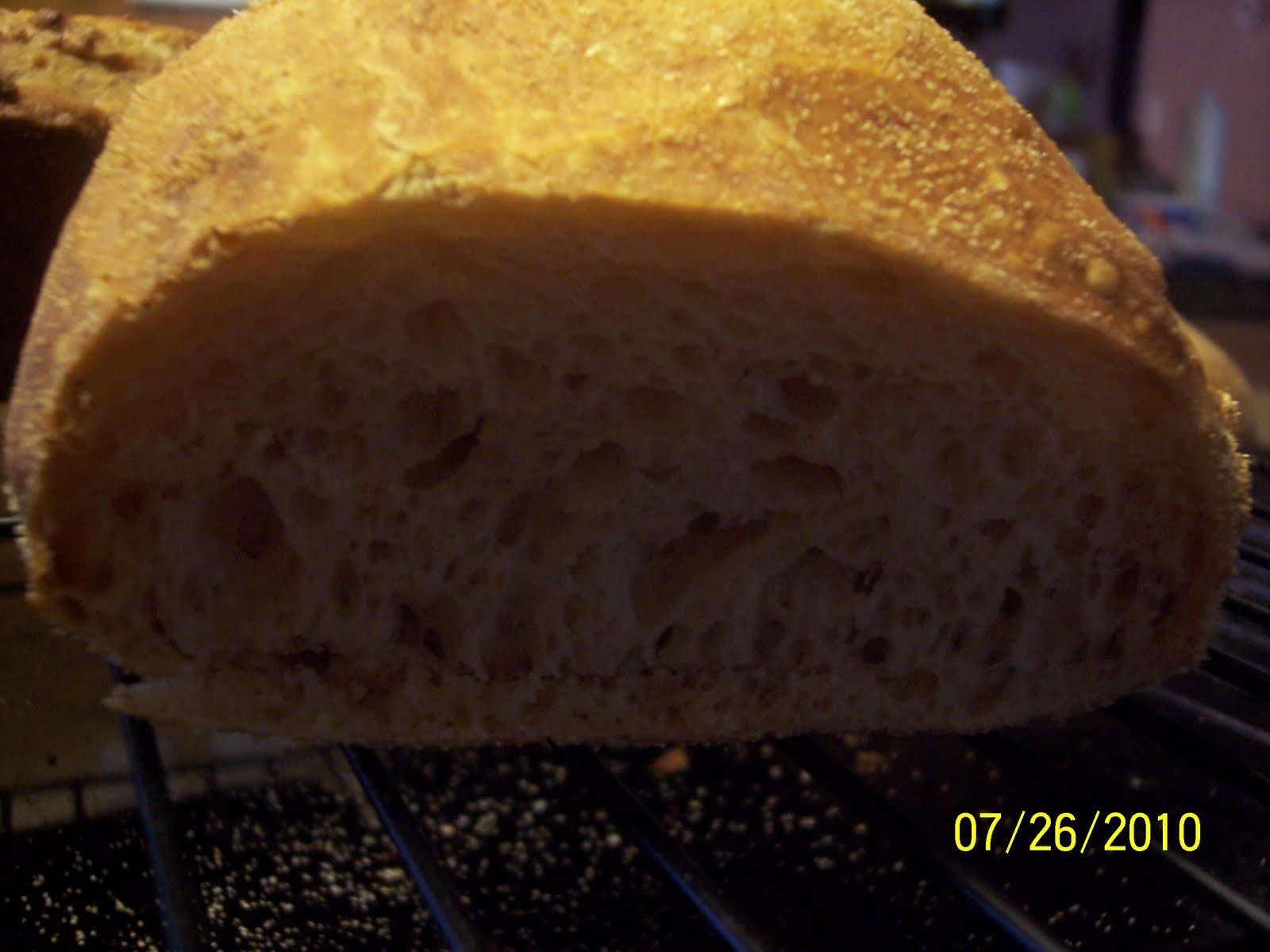
We tested both breads a few hours later.  Both had a nice crust, although the one on the stone had a crisper crust.  Both had a nice, open crumb:    


And the taste?

My hubby said the bread baked in the covered Corningware tasted
like French bread.  He said the other tasted like "something else." 


I thought the Corningware one tasted kind of flat, and the one on the stone tasted like "extra" flavor.  Actually, the one on the stone tasted like the master dough boule bread from “Artisan Breads in 5 Minutes a Day.”  But you really tasted more true bread flavor from the covered Corningware method.


We were really surprised to find that the breads tasted differently, because they came from the same batch of dough.

I brought both breads to my yoga class for taste tests.  People liked both of them, but one woman made an especially interesting comment.  She said she was sensitive to yeast at one time, and could really taste the yeast on the bread baked on the stone.  She didn’t taste the yeast on the bread baked in the covered Corningware casserole pot.  She suggested that maybe the enclosed method killed more of the yeast, so you didn’t taste it in the baked product.


My husband and I ate the remaining bread, now that it's a day older.  The taste difference showed up even more.


The verdict?  This bread is worth the purchase of another pan  If the taste of the bread is that much better in a Corningware casserole dish, then the crust should be even better in a cast iron dutch oven.  After doing my research on various cast iron pans, I ordered a Tramontina 6.5 Qt. Cast Iron Dutch Oven.  It had high reviews from people using it.  


BUT--I will check out the weight of the dutch oven before I buy it.  I'll have to consider adding a few pounds of dough, too.  It might be too heavy.  Or, I might ask my hubby to put the bread in the oven.

If I don't buy the pot, the recipe is still good in the Corningware casserole dish.


__________
Handwise tips:  If you have hand pain, tendonitis, or arthritis or any other pain issues and want to make this recipe,
  1. This is a very wet dough, and pretty easy to mix.  Many people could probably make the dough.  However, you may need help manuevering the cast iron pot--it's pretty heavy!
  2. Consider making it in a covered casserole dish,  it's still pretty good that way.
  3. Soak your tools in your empty dough bucket or a pan when you are finished using them.   That way, you can wash them easily later (or tomorrow!)  Give yourself the permission of time to clean up much later.
___________

Thanks for coming by my blog.  I hope the test results have been helpful to you.  Please leave a comment before going, and stop by again!